
The African continent, the sub-Saharan region, has been confronted since its accession to independence with several challenges: getting rid of neocolonialism, creating regional economic communities, implementing the free movement of people, goods and services to establish a common market. It is in this context that CEMAC (Economic and Monetary Community of Central Africa) was created on March 16, 1994, made up of the following states: Cameroon, Gabon, Equatorial Guinea, Congo Brazzaville, Chad and Central African Republic. Cameroon, until the recent conflicts in the western and northern regions, was considered a country of peace and as such welcomes many Central African nationals on its territory. These Central African nationals are seeking to improve their well-being. Thus, the city of Douala, the economic capital of Cameroon, renowned for offering economic opportunities, was chosen as the destination city by many of these migrants. This analysis of the problem of socio-economic integration of these Central Africans in Douala took place in a socio-historical context, adopting the mixed method which includes both quantitative and qualitative data. Four groups of Central African nationals were the subject of this analysis: legal residents, refugees, asylum seekers and students. Their experience during the period 2003 to 2020 through labor market institutions, housing, health and education was assessed in comparison with that of Cameroonian urban dwellers in the light of CEMAC public integration policies. Cameroon and the urban community of Douala. No evidence of xenophobia on the part of Douala city dwellers was found.
| Published in | Humanities and Social Sciences (Volume 13, Issue 2) |
| DOI | 10.11648/j.hss.20251302.20 |
| Page(s) | 170-177 |
| Creative Commons |
This is an Open Access article, distributed under the terms of the Creative Commons Attribution 4.0 International License (http://creativecommons.org/licenses/by/4.0/), which permits unrestricted use, distribution and reproduction in any medium or format, provided the original work is properly cited. |
| Copyright |
Copyright © The Author(s), 2025. Published by Science Publishing Group |
Regional Economic Communities, Urban Community of Douala, Socio-economic Integration, Xenophobia, CEMAC, Migrants
Statuts | Legal | Refugees | Asylum seekers | Students | Total |
|---|---|---|---|---|---|
Number | 30 | 45 | 10 | 15 | 100 |
Gender | 18 men 12 women | 17 men 28 women | 2 men 8 women | 10 men 5 women | 47 men 53 women |
Household size | 22 with children 08 without children | 39 with children 6 without children | 10 with children | No children | 71 with children 29 without children |
Age | 18 M=30+ 09 W= 30+ | 15 M=30+ 10 W= 30+ | 2 M= 30+ 2 W= 30+ | 10 M= 30- 05 W = 30- | 35 M = 30+ 21 W = 30+ 12 M = 30- 32 W = 30- |
Arrival date | 13 M before 2016 05 M after 2016 12 W after 2016 | 28 W before 2016 17 M before 2016 | 08 W after 2016 02 M after 2016 | 03 M before 2016 02 W before 2016 07 M after 2016 03 F after 2016 | 33 M before 2016 14 M after 2016 30 W before 2016 23 W after 2016 |
Branch of activities | Legal | Refugees | Asylum seekes | Total/85 | ||||
|---|---|---|---|---|---|---|---|---|
Gender | Masculin | Feminine | Masculin | Feminine | Masculin | Feminine | Masculin | Feminine |
Primary | Agriculture | Agriculture | Agriculture | Agriculture | Agriculture | 04 | 16 | |
Industry/buildings | 02- Wood sawmills 02- Masonry 01- Soapworks 01- Pastry | 07-Masonry 01-Pastry 01-printing house 01-Wood sawmills | 02 Masonry | 18 | 00 | |||
Trade | 03-Clothing sale 02-Sale of alcoholic beverages | 02-Sale of food 05-Clothing sale | 01-Shopkeeper 01-Sale of local drinks | 07-Sale of peanuts 03-Sale of food | 05-Sale of peanuts | 07 | 22 | |
Services | 02- Handlers at the port 01-Baker 01-Maintenance agent | 04- Vigils | 05-Maintenance workers 03-Housekeepes 02-Vigils | 08 | 10 | |||
CAN | Central African Nationals |
CEMAC | Economic and Monetary Community of Central Africa |
CIC | Cameroon Institute of Cartography |
EC | Echo Crisis |
UCD | Urban Community of Douala |
UNHCR | United Nations High Commissioner for Refugees |
| [1] | Avom, D. & Gbetkom, D. 2003. Surveillance multilatérale des politiques budgetaires dans la zone CEMAC: bilan et perspectives. Monde en Développement. 3(123): 107-125. |
| [2] |
CEMAC. 2013. Examen des politiques commerciales. [online]. Disponible:
https://www.wto.org/french/tratop_f/tpr_f/tpr_f/tp385_f.htm [2020, november 6]. |
| [3] | Chauvin, E. & Seignobos, C. 2013. L’imbroglio centrafricain Etat, rebelles et bandits. Afrique contemporaine. 4(248): 119–148. |
| [4] |
Echo Crisis. 2014. European Commission/Humitarian Aid and civil protection République centrafricaine: impacts régionaux. [Online], Available:
https:www.europarl.europa.eu/meetdocs/2009_2014/documents/deve/dv/car_echo_crisis_report_/car_echo_crisis_report_fr.pdf [2019 may 10]. |
| [5] | Evina, C. 2009. Migration au Cameroun, profil national 2009. Genève. OIM |
| [6] | Feussi, V. 2011. Migrance, langue et spatialistion urbaine à Douala, Cameroun. Cahiers internationaux de sociolinguistigue. 1(1): 11–31. |
| [7] | Gatsi Tazo, A. 2009. Les conditions juridiques des étrangers en zone CEMAC. Contribution au diagnostic de l’intégration personnelle en zone CEMAC. Mémoire de DEA en droit. Dschang: Université de Dschang. |
| [8] | Hatcheu, E. 2000. Les commercants et les transporteurs dans l’approvisionnement vivrier et la distribution à Douala (Cameroun). Bulletin de l’APAD. [Online]. Available, [2019-06-12]. |
| [9] | Institut Camerounais de la Statistique. 2019. Annuaire Statistitique de la Région du Littoral. [Yaoundé]: Bureau central de l'INS |
| [10] | Kamdem, P. 2016. Scolarisation et vulnérabilité : les enfants réfugiés centrafricains dans la région de l’Est-Cameroun , Espace populations sociétés. [Online]. Available: [2019 june 5]. |
| [11] | Kingue, E. & Ntoh, G. 2017. Vivre ensemble à Douala le dynamisme de la diversite. Cahier de la Communauté Urbaine de Douala. (011): 2-23. |
| [12] |
Ngaibino, E. 2014. Douala: deuxième ville importante de la RCA après Bangui. NID2TIC [online]. Available:
https://nid2tic.mondoblog.org/doual-deuxième-ville-importante-de-la rca-apr-bangui/ [2019, April 18]. |
| [13] | Nguemo Taya, G. 2019. L’insertion socio-économique des réfugiés urbains au Cameroun. L’expérience des réfugiés centrafricains dans la ville de Douala. Mauritius: Editions Universitaires Européenne. |
| [14] | North, D. 1990. Institution, Ideology and Economic Performance. New York: Cambridge University Press. |
| [15] | Président de la République du Cameroun. 1994. Décret portant statut général de la fonction publique. Cameroun: SGPR. |
| [16] | Président de la République du Cameroun. 2005. Loi portant statut des réfugiés au Cameroun. Yaoundé: SGPR. |
| [17] | République centrafricaine. 1970. Ordonnance portant réforme agraire. République centrafricaine. Bangui: FAOLEX. |
| [18] | UNHCR. 2013. Vers un nouveau départ. Bruxelles: UNHCR. |
| [19] |
UNHCR. 2019. Cameroon: Douala - Map of urban refugees and asylum seekers by area of residence (December 2019). [online]. Available:
https://reliefweb.int/map/cameroon/cameroon-douala-map-urban-refugees-and-asylum-seekers-area-residence-december-2019 [2020-01-15]. |
APA Style
Onana, S. S. N., Bekker, S. (2025). Migrants from the Central African Republic, a War Country, Living in Douala, Cameroon (2020). Humanities and Social Sciences, 13(2), 170-177. https://doi.org/10.11648/j.hss.20251302.20
ACS Style
Onana, S. S. N.; Bekker, S. Migrants from the Central African Republic, a War Country, Living in Douala, Cameroon (2020). Humanit. Soc. Sci. 2025, 13(2), 170-177. doi: 10.11648/j.hss.20251302.20
AMA Style
Onana SSN, Bekker S. Migrants from the Central African Republic, a War Country, Living in Douala, Cameroon (2020). Humanit Soc Sci. 2025;13(2):170-177. doi: 10.11648/j.hss.20251302.20
@article{10.11648/j.hss.20251302.20,
  author = {Serge Sabine Ntsama Onana and Simon Bekker},
  title = {Migrants from the Central African Republic, a War Country, Living in Douala, Cameroon (2020)
},
  journal = {Humanities and Social Sciences},
  volume = {13},
  number = {2},
  pages = {170-177},
  doi = {10.11648/j.hss.20251302.20},
  url = {https://doi.org/10.11648/j.hss.20251302.20},
  eprint = {https://article.sciencepublishinggroup.com/pdf/10.11648.j.hss.20251302.20},
  abstract = {The African continent, the sub-Saharan region, has been confronted since its accession to independence with several challenges: getting rid of neocolonialism, creating regional economic communities, implementing the free movement of people, goods and services to establish a common market. It is in this context that CEMAC (Economic and Monetary Community of Central Africa) was created on March 16, 1994, made up of the following states: Cameroon, Gabon, Equatorial Guinea, Congo Brazzaville, Chad and Central African Republic. Cameroon, until the recent conflicts in the western and northern regions, was considered a country of peace and as such welcomes many Central African nationals on its territory. These Central African nationals are seeking to improve their well-being. Thus, the city of Douala, the economic capital of Cameroon, renowned for offering economic opportunities, was chosen as the destination city by many of these migrants. This analysis of the problem of socio-economic integration of these Central Africans in Douala took place in a socio-historical context, adopting the mixed method which includes both quantitative and qualitative data. Four groups of Central African nationals were the subject of this analysis: legal residents, refugees, asylum seekers and students. Their experience during the period 2003 to 2020 through labor market institutions, housing, health and education was assessed in comparison with that of Cameroonian urban dwellers in the light of CEMAC public integration policies. Cameroon and the urban community of Douala. No evidence of xenophobia on the part of Douala city dwellers was found.
},
 year = {2025}
}
TY  - JOUR
T1  - Migrants from the Central African Republic, a War Country, Living in Douala, Cameroon (2020)

AU  - Serge Sabine Ntsama Onana
AU  - Simon Bekker
Y1  - 2025/04/17
PY  - 2025
N1  - https://doi.org/10.11648/j.hss.20251302.20
DO  - 10.11648/j.hss.20251302.20
T2  - Humanities and Social Sciences
JF  - Humanities and Social Sciences
JO  - Humanities and Social Sciences
SP  - 170
EP  - 177
PB  - Science Publishing Group
SN  - 2330-8184
UR  - https://doi.org/10.11648/j.hss.20251302.20
AB  - The African continent, the sub-Saharan region, has been confronted since its accession to independence with several challenges: getting rid of neocolonialism, creating regional economic communities, implementing the free movement of people, goods and services to establish a common market. It is in this context that CEMAC (Economic and Monetary Community of Central Africa) was created on March 16, 1994, made up of the following states: Cameroon, Gabon, Equatorial Guinea, Congo Brazzaville, Chad and Central African Republic. Cameroon, until the recent conflicts in the western and northern regions, was considered a country of peace and as such welcomes many Central African nationals on its territory. These Central African nationals are seeking to improve their well-being. Thus, the city of Douala, the economic capital of Cameroon, renowned for offering economic opportunities, was chosen as the destination city by many of these migrants. This analysis of the problem of socio-economic integration of these Central Africans in Douala took place in a socio-historical context, adopting the mixed method which includes both quantitative and qualitative data. Four groups of Central African nationals were the subject of this analysis: legal residents, refugees, asylum seekers and students. Their experience during the period 2003 to 2020 through labor market institutions, housing, health and education was assessed in comparison with that of Cameroonian urban dwellers in the light of CEMAC public integration policies. Cameroon and the urban community of Douala. No evidence of xenophobia on the part of Douala city dwellers was found.

VL  - 13
IS  - 2
ER  -
Department of History, University of Yaoundé I, Yaoundé, Cameroon
Department of History, University of Yaoundé I, Yaoundé, Cameroon
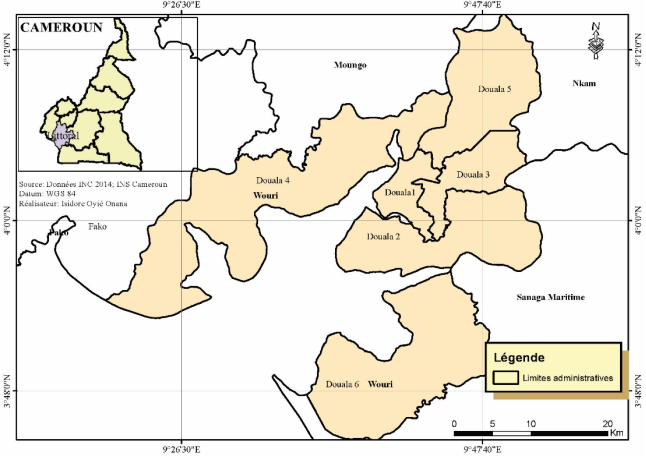
Figure 1. Administrative division of the city of Douala.
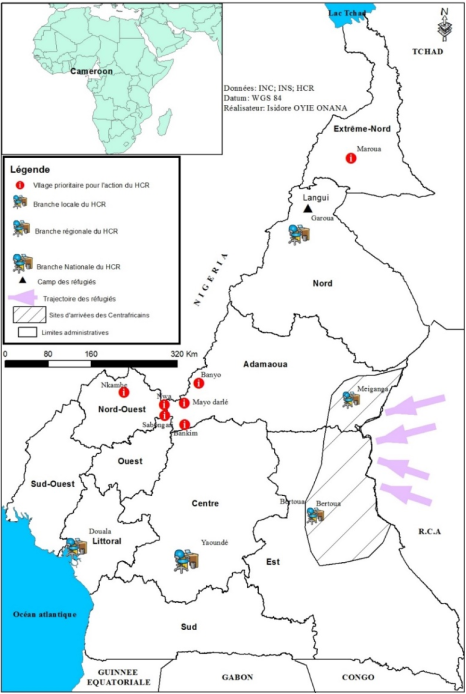
Figure 2. Itineraries, facilities of UNHCR and Central African offices in Cameroon.
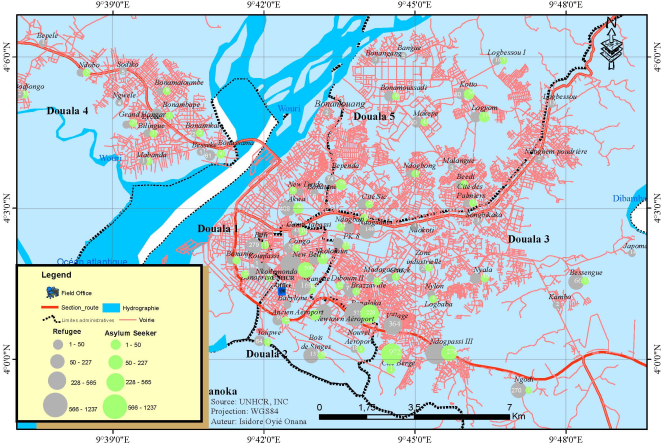
Figure 3. Settlement of refugees and asylum seekers in the city of Douala in 2019.
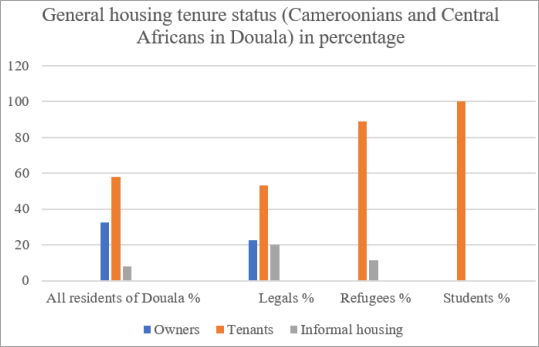
Figure 4. General housing tenure status (Cameroonians and Central Africans in Douala) in percentage.

Information



 Share This Article
 Twitter
 Linked In
 Facebook
 Copy
Copy Download