Abstract
This article aims to understand, from Karl Polanyi's perspective, how cooperativism can contribute to building sustainable solutions to population aging, with an emphasis on rural contexts. The global phenomenon of population aging, characterized by a proportional increase of older adults in the total population due to declining birth rates and increased life expectancy, presents significant and complex challenges, particularly in rural areas where structural weaknesses and the scarcity of effective public policies are more pronounced. In this context, the study argues that cooperativism emerges as a viable and robust alternative for social inclusion, care, and autonomy for older adults. The theoretical framework is anchored in Polanyi's critique of the commodification of social life, particularly his concept of the “disembeddedness” of the economy from the social fabric. The analysis connects Polanyi's principles of reciprocity, redistribution, and domesticity with the core values and principles of cooperativism, highlighting the capacity of this model of economic organization to promote the “re-embedding” of the economy into social norms and values. The study adopts a qualitative, bibliographical, and documentary approach, utilizing data from key national and international organizations, such as the World Health Organization (WHO), the United Nations (UN), the Brazilian Institute of Geography and Statistics (IBGE), and the International Cooperative Alliance (ICA), to characterize the demographic shift and identify the practical role of cooperatives. The analysis presents concrete examples of the actions of different branches of cooperativism in addressing aging in rural areas, accentuating their contribution to the appreciation of traditional knowledge, income generation, and the strengthening of community networks. The findings indicate that cooperativism represents not only an economic response to the challenges of aging but also an integrated and supportive regional development strategy. It is capable of transforming aging into an opportunity for the collective reconstruction of territories, strengthening the dignity and empowerment of older adults by promoting a more socially and environmentally sustainable economic model.
|
Published in
|
Humanities and Social Sciences (Volume 14, Issue 1)
|
|
DOI
|
10.11648/j.hss.20261401.11
|
|
Page(s)
|
1-9 |
|
Creative Commons
|

This is an Open Access article, distributed under the terms of the Creative Commons Attribution 4.0 International License (http://creativecommons.org/licenses/by/4.0/), which permits unrestricted use, distribution and reproduction in any medium or format, provided the original work is properly cited.
|
|
Copyright
|
Copyright © The Author(s), 2026. Published by Science Publishing Group
|
Keywords
Cooperativism, Population Aging, Reinstatement, Regional Development, Social Protection
1. Introduction
Population aging is one of the most significant phenomena of the 21st century. This phenomenon, experienced worldwide, is primarily attributed to declining birth rates and increasing life expectancy. According to the World Health Organization (WHO), between 2015 and 2030, the number of older adults will grow by 56%, from 901 million to 1.4 billion. Projections for 2050 indicate an even more significant increase, reaching 2.1 billion worldwide
.
In Brazil, census data indicate that the country currently has 32.1 million elderly people, which represents approximately 15.8% of the Brazilian population. However, projections indicate that over the next few decades, these numbers will continue to increase, with the estimate that, by 2060, approximately 25% of Brazilians will be 60 years of age or older
| [2] | Brazilian Institute of Geography and Statistics (IBGE). Continuous National Household Sample Survey. IBGE, 2023. Available at: https://censo2010.ibge.gov.br Accessed on: 19 Jul. 2025. |
[2]
.
Given the growing visibility of population aging on a global scale, the topic has become a more systematic part of the agenda of international organizations
| [3] | Camarano, A. A.; Pasinato, M. T. O envelhecimento populacional na agenda das politicas publicas [Population aging on the public policy agenda]. In: Camarano, A. A. (ed.). Os novos idosos brasileiros: muito alem dos 60. Rio de Janeiro: IPEA, 2004, p. 253–292. |
[3]
. In this context, the United Nations (UN) has played a central role in expanding the debate on the challenges and opportunities associated with aging, alerting member states to the urgent need to formulate and implement public policies aimed at this growing demographic segment.
In regional and rural contexts, this trend is even more challenging, given structural weaknesses and the even greater scarcity of effective public policies.
In this scenario, cooperativism emerges as a viable alternative for social inclusion, care, and autonomy for older adults. This is because cooperativism is a socioeconomic model that proposes new ways of organizing economic life, based on values such as solidarity, equity, democracy, and respect for the environment
| [4] | Frantz, W. Associativismo, cooperativismo e economia solidaria. Ijuí: Editora Unijui, 2012. |
[4]
.
Given the above and based on a qualitative methodological approach with a descriptive and exploratory design, this study aims to understand, from Karl Polanyi's perspective, how cooperativism can contribute to the construction of sustainable solutions in the face of population aging, with an emphasis on rural contexts.
The study's structure comprises seven sections. The first one presents introductory notes, outlining the objective and structure; the second one presents methodological procedures; the third one discusses the challenges and trends of population aging, especially in rural contexts; the fourth analyzes Karl Polanyi's critique of the commodification of social life; the fifth section explores cooperativism as a strategy for reintegrating the economy in aging rural territories; the sixth addresses the connections between cooperativism, aging, and regional development, bringing out the transformative potential of cooperative practices; and, finally, the seventh section presents the work's concluding remarks.
2. Methodological Procedures
To meet the study's objective, a qualitative approach was adopted, of a descriptive and exploratory nature, using bibliographic and documentary procedures
| [5] | Yin, R. K. Qualitative Research from Start to Finish. Porto Alegre: Penso, 2016. |
[5]
.
The bibliographic process involved surveying and reviewing previously published works on the topic, including books and scientific articles. According to Gil, bibliographic research “(...) is developed based on previously developed material, consisting primarily of books and scientific articles”
| [6] | Gil, A. C. Methods and Techniques of Social Research. 6th ed. Sao Paulo: Atlas, 2008. |
[6]
. From this perspective, searches for articles were conducted in June and July 2025 in scientific journal databases, using relevant keywords such as: population aging in rural areas, cooperativism, and cooperatives. Furthermore, the bibliographic research included classical and contemporary authors addressing substantive economic theory, cooperativism, and demographic transformations. Karl Polanyi's theoretical framework constitutes the central axis of the analysis, being mobilized to interpret forms of economic organization based on reciprocity, redistribution, and domesticity, as opposed to the logic of the self-regulated market.
The documentary process encompasses the analysis of technical reports and data from national and international organizations, such as the World Health Organization (WHO), the Brazilian Institute of Geography and Statistics (IBGE), the Organization of Brazilian Cooperatives (OCB), the United Nations Population Fund (UNFPA), and the Paraná Institute for Economic and Social Development (IPARDES), with the goal of characterizing population aging and identifying the role of cooperatives in addressing this phenomenon.
The methodological approach (consisting of Karl Polanyi's theoretical framework along with the exploration of documentary data) demonstrated how cooperativism can contribute to the development of sustainable solutions to address population aging.
3. Population Aging: Challenges and Trends in Rural Contexts
Population aging is a phenomenon characterized by a proportional increase of older adults in the total population. This phenomenon began in the 19th century in some developed European countries, and today it encompasses countries worldwide, with a more pronounced impact in developing countries
| [7] | Carvalho, J. A. M.; Garcia, R. A. O envelhecimento da populacao brasileira: um enfoque demografico. Caderno de Saude Publica, Rio de Janeiro, 2003, p. 725–733. |
[7]
.
Population aging is the result of changes in society's age structure, particularly the combination of declining fertility rates and the increasing proportion of older adults
| [8] | Wong, L. L. R.; Carvalho, J. A. M. O rapido processo de envelhecimento populacional do Brasil: serios desafios para as politicas publicas. Revista Brasileira de Estudos de Populacao, v. 23, n. 1, p. 5–26, 2006. |
[8]
. These two interrelated factors directly contribute to the rising aging rate and promote significant demographic changes.
Fertility has been declining over the past few decades, with the current global fertility rate at 2.25 live births per woman, projected to fall to 2.1 by the end of the 2040s. Meanwhile, global life expectancy at birth reached an average of 73.3 years in 2024. It is estimated that, with continued reductions in mortality rates, this average will rise to approximately 77.4 years by 2054
.
According to a report by the United Nations Population Fund (UNFPA), global population growth is slowing, while longevity rates are rising. This scenario has resulted in continued growth in the global elderly population, expected to quadruple in the next 50 years
| [10] | United Nations. International Plan of Action on Ageing. Brasilia: Secretaria Especial dos Direitos Humanos, 2003. |
[10]
, as shown in
Figure 1.
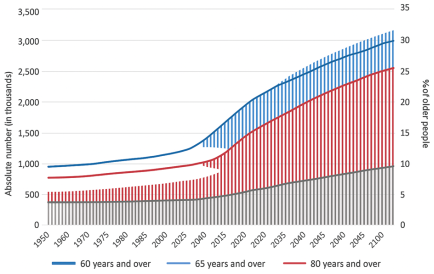
Figure 1. Absolute and relative population of older people aged 60 and over, 65 and over, and 80 and over in the world between 1950-2100.
The figure shows the evolution of the global elderly population between 1950 and the projection until 2100, segmented by age groups (60 years and older, 65 years and older, and 80 years and older), both in absolute numbers (in thousands) and as a percentage of the total population. Significant growth in the elderly population has been observed since 2000, with a notable acceleration between 2020 and 2050, highlighting the urgent need to rethink development models, social protection policies, and inclusion strategies to address the impacts of population aging.
In Brazil, the rapid increase in the elderly population is disturbing. According to statistical data from the Brazilian Institute of Geography and Statistics (IBGE), in 2010, the Brazilian elderly population was 20.5 million. In 2022, this number increased to 32.1 million, representing 15.8% of the country's population
| [2] | Brazilian Institute of Geography and Statistics (IBGE). Continuous National Household Sample Survey. IBGE, 2023. Available at: https://censo2010.ibge.gov.br Accessed on: 19 Jul. 2025. |
[2]
. And now, in 2025, according to the UN, Brazil will rank sixth in the world among countries with the largest elderly population.
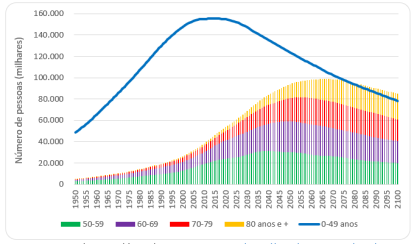
Figure 2. Population aged 0-49, 50-59, 60-69, 70-79, and 80 and over, Brazil: 1950-2100.
Figure 2 shows the evolution and projection of the age distribution of the world population between 1950 and 2100, in absolute numbers of people, evidencing accelerated growth of the elderly population between 1950 and 2025, reaching a peak around 2045–2050. This finding and projection reinforces the population aging scenario with significant consequences for public policy planning, health systems, social security, the labor market, and regional development.
This demographic panorama poses significant challenges to public policies aimed at meeting the demands of the growing elderly population. Specifically, when analyzing aging in rural areas, the literature shows that since the 1990s, a dual process has been occurring: the masculinization of the resident population and the advancing aging of this same rural population. These dynamics configure more specific structural transformations, directly impacting agricultural production and the economy of these territories
.
Population aging in rural areas creates a series of socioeconomic challenges that directly affect the quality of life of older adults and the sustainability of communities. One of the most significant and urgent impacts of population aging in rural areas is food security. The reduction in the young workforce and the increasing difficulties in family succession in rural areas compromise the continuity of agricultural activities, potentially resulting in a significant decline in agricultural production. This scenario affects not only the local economy but also the food supply capacity on a regional and national scale
.
Based on this data, it can be observed that by the year 2050 there will be a 33.3009% increase in the total population and a 12% reduction in the rural population. Meanwhile, the population aged 60 or older in the municipality of Pato Branco, Paraná, will increase by 107.4950% in 2050 compared to the current year of 2025.
Given this scenario, it becomes clear that population aging, especially in rural areas, is not an isolated phenomenon, but rather intrinsically linked to structural transformations in society, reflecting on multiple dimensions of economic, social, and territorial life. The decline in the young workforce, the fragility of support networks, and the lack of effective public policies exacerbate inequalities and jeopardize the sustainability of rural communities.
In this context, it is essential to reflect on socioeconomic alternatives capable of addressing
these challenges in an integrated and supportive manner. Karl Polanyi's theoretical perspective fits into this context, as his critique of the commodification of social life offers relevant insights for rethinking development models and understanding how economic forms rooted in reciprocity, such as cooperativism, can contribute to building sustainable responses to population aging.
4. Karl Polanyi and the Critique of the Commodification of Social Life
In his classic work
The Great Transformation, Polanyi argues that liberal capitalism has promoted the commodification of three fundamental elements: land, labor, and money. For him, these elements are “fictitious commodities,” as they were not originally produced for the market
| [13] | Polanyi, K. The Great Transformation: The Political and Economic Origins of Our Time. 2nd ed. Rio de Janeiro: Campus, 2000. |
[13]
. The forced insertion of these elements into market relations ruptures social bonds, leading to what Polanyi calls the “disembeddedness” of the economy—that is, it “detaches” itself from society and begins to act autonomously, in such a way that all social relations are subordinated to the logic of the market. In response, the author states that society tends to react through protection and reintegration mechanisms, promoting the “recessing” of the economy in social life, that is, reintegrating the economy into the social fabric, placing it at the service of society, and not the other way around. This approach underpins the idea of a substantive economy, which considers economic systems in their institutional and social dimensions, and not just as mercantile exchanges, seeking to reinstate the economy in social norms and values
| [13] | Polanyi, K. The Great Transformation: The Political and Economic Origins of Our Time. 2nd ed. Rio de Janeiro: Campus, 2000. |
[13]
.
Substantive economy adopts a more universal approach, integrating human beings with their natural and social environment to ensure survival and the continuous supply of the material means necessary to satisfy their needs. This substantive connotation is universal because all societies, regardless of their specific organization, must somehow ensure their subsistence
| [13] | Polanyi, K. The Great Transformation: The Political and Economic Origins of Our Time. 2nd ed. Rio de Janeiro: Campus, 2000. |
[13]
.
According to Polanyi, the idea of a completely free and self-regulating market is unfeasible and self-destructive to the foundations of social life
| [13] | Polanyi, K. The Great Transformation: The Political and Economic Origins of Our Time. 2nd ed. Rio de Janeiro: Campus, 2000. |
[13]
. For the author, an economic system that invalidates all aspects of social life to the logic of the market cannot be sustained without causing social collapse. Criticizing the nineteenth-century economic system and neoliberalism, the author emphasizes that the economy must be embedded in society, not the other way around, proposing a substantive and integrative approach to economic relations
| [13] | Polanyi, K. The Great Transformation: The Political and Economic Origins of Our Time. 2nd ed. Rio de Janeiro: Campus, 2000. |
[13]
.
In this context, a self-regulated market breaks with the logic of the economy being embedded in society, disregarding, thus, the various other historical and cultural forms of economic organization that are not based exclusively on commodity exchange. In this sense, the author emphasizes four principles of integration that organize economic life in societies: market, reciprocity, redistribution, and householding. These principles guide the ways in which goods and services are produced, distributed, and consumed, thereby revealing the diverse ways in which economic life can be organized
| [13] | Polanyi, K. The Great Transformation: The Political and Economic Origins of Our Time. 2nd ed. Rio de Janeiro: Campus, 2000. |
[13]
.
For Polanyi, before the emergence of the self-regulated market economy, societies were structured based on these principles, which reinforces his critique of the disintegration of social relations caused by the commodification of economic life
| [13] | Polanyi, K. The Great Transformation: The Political and Economic Origins of Our Time. 2nd ed. Rio de Janeiro: Campus, 2000. |
[13]
.
The market represents the meeting of supply and demand for goods and services for the purpose of exchange, adjusted by price and mediated by currency. Reciprocity is based on the mutual exchange of goods and services between individuals or groups that maintain stable social relationships, such as kinship or traditional communities. In this model, exchange is not aimed at profit, but rather at a commitment to the continuity of relationships and social bonds
| [13] | Polanyi, K. The Great Transformation: The Political and Economic Origins of Our Time. 2nd ed. Rio de Janeiro: Campus, 2000. |
[13]
.
Redistribution involves the centralization of goods in an authority (such as a chief, temple, or state), which stores them and subsequently redistributes them among community members according to social or political norms. This principle is characteristic of more complex societies, where the control and management of surplus play an essential role in maintaining social order and the exercise of power
| [13] | Polanyi, K. The Great Transformation: The Political and Economic Origins of Our Time. 2nd ed. Rio de Janeiro: Campus, 2000. |
[13]
.
Domesticity is associated with production for personal consumption, carried out within the home or community. It is typical of family units, villages, or fiefdoms that aim for self-sufficiency rather than market entry. This model emphasizes subsistence, the direct use of resources, and the continuity of daily life
| [13] | Polanyi, K. The Great Transformation: The Political and Economic Origins of Our Time. 2nd ed. Rio de Janeiro: Campus, 2000. |
[13]
.
Understanding these principles reveals the recognition that the organization of societies has not historically been limited to mercantile logic. Before the emergence of the self-regulated market economy, societies were structured based on these principles, which reinforces their critique of the disintegration of social relations caused by the commodification of economic life
| [13] | Polanyi, K. The Great Transformation: The Political and Economic Origins of Our Time. 2nd ed. Rio de Janeiro: Campus, 2000. |
[13]
.
Considering Polanyi's theory regarding the impacts of the commodification of social life and the disruption caused by the disembeddedness of the economy, it becomes necessary to seek alternatives capable of reversing this process and reestablishing the economy’s integration into the social fabric. In this context, cooperativism emerges as a concrete and viable response, configuring itself as a form of economic organization based on solidarity, interdependence, and collective self-management. Thus, the next section will address cooperativism as a strategy for socioeconomic reembeddedness, with special attention to rural contexts impacted by population aging.
5. Cooperativism as a Strategy for Socioeconomic Re-embedding in Aging Rural Areas
Cooperativism, as a form of economic organization based on self-management, democratic participation, and solidarity, represents an important mechanism for re-embedding the economy in social relations. It is a model that transcends the strict logic of commodity exchange. It incorporates social, collective, and subsistence issues and promotes the integration of economic activity with the communities’ values and needs in which it operates.
Cooperativism is defined as an association of people who voluntarily unite to meet common economic, social, and cultural needs and aspirations through a collectively owned and democratically controlled organization. By uniting around a shared purpose, individuals enhance their capabilities and achieve significantly superior results than they would have achieved only by themselves
.
According to Paul Singer, cooperativism is part of the field of the solidarity economy, understood as a set of economic practices based on self-management, cooperation, and the primacy of labor over capital. For the author, cooperatives represent organizational forms that resist structural unemployment and the precariousness of labor relations, configuring themselves as concrete alternatives for income generation, productive inclusion, and strengthening the local economy
| [15] | Singer, P. Introduction to Solidarity Economy. Sao Paulo: Fundacao Perseu Abramo, 2002. |
[15]
.
Besides being a socioeconomic model, especially in its solidarity-based aspect, cooperativism constitutes a new social movement that seeks to redefine the relationships between economy, politics, and society
| [16] | Gaiger, L. I. Solidarity Economy in Motion: Faces and Challenges of a New Social Movement. In: Gaiger, L. I. (Org.). Meanings and Practices of Solidarity Economy in Brazil. Porto Alegre: UFRGS, 2004. |
[16]
. Therefore, by countering the market logic that uproots economy from society, cooperativism seeks to reintegrate economic activities into the social fabric, prioritizing collective well-being and solidarity.
Consequently, linking cooperativism to the strategy of socioeconomic reincorporation/reintegration implies understanding it as a practical and theoretical response to historical processes that demonstrate the advance of market logic over social relations. Cooperativism emerges, in this context, as a form of self-protection for society, constituting an attempt to reorganize the economy based on principles of solidarity, clustering labor, land, and the means of production into social and community dynamics, in contrast to the logic of capital accumulation
| [4] | Frantz, W. Associativismo, cooperativismo e economia solidaria. Ijuí: Editora Unijui, 2012. |
[4]
.
In this sense, the principles of economic integration in societies discussed by Polanyi have an intrinsic relationship with the socioeconomic model of cooperativism.
Table 1. Comparison between the Principles of Economic Integration (Polanyi) and Cooperativism.
Principles of Economic Integration (Polanyi) | Fundamentals of Cooperativism | Relationships and Convergences |
Reciprocity: Exchanges based on symmetry, solidarity and trust relationships between members of a community. | Solidarity and mutual aid: Cooperative foundation based on unity and interdependence among members. | Both value economic relationships sustained by social and community ties, and not exclusively by profit. |
Redistribution: Allocation of resources from a center or authority and subsequently redistributing them among community members, promoting equity. | Democratic and equitable management: Decisions are made collectively; surpluses are distributed proportionally or reinvested in the group. | Cooperativism incorporates internal redistributive practices, seeking equity and collective well-being of cooperative members. |
Domesticity: Production and consumption aimed at the subsistence of the family group or community. | Self-management and sustainability: Production oriented towards satisfying the needs of cooperative members, based on conscious and sustainable consumption. | Both reject the centrality of the market, prioritizing local autonomy and the social reproduction of subjects. |
Market: The meeting of supply and demand for goods and services for the purpose of exchange, adjusted by price and mediated by currency. | Solidarity economy and resistance to market logic: Cooperativism offers an alternative to mercantile logic, seeking to humanize economic relations. | Cooperativism responds critically to the disintegration caused by the self-regulated market, defending socially rooted economic practices. |
Source: Prepared by the author, based on Polanyi (2000) and (Frantz, 2012)
Based on the data presented in
Table 1, a strong relationship can be observed between the principles of economic integration described by Karl Polanyi and the foundations of cooperativism. When compared, it became clear that cooperativism not only aligns with the substantive principles proposed by Polanyi but also constitutes a concrete alternative to the weaknesses of the market economy.
Cooperativism’s emphasis on solidarity, reciprocity, and collective resource management presents itself as a viable and effective alternative to the weaknesses imposed by population aging. This approach strengthens the social fabric, builds more inclusive and resilient territories prepared to deal with ongoing demographic transformations, and creates support networks that value the autonomy, dignity, and protagonism of older adults, especially in contexts marked by social vulnerability, such as aging rural areas.
According to data from the Organization of Brazilian Cooperatives (OCB), by 2023, Brazil had 4,509 registered cooperatives, distributed across various sectors of the economy, such as agriculture, credit, health, labor, transportation, consumer goods, and education. These cooperatives were present in more than 3,600 Brazilian municipalities, demonstrating their broad territorial reach and strategic role in promoting local development
.
Table 3 presents the total number of Brazilian cooperatives by sector in 2023, with data for 2024 still unavailable.
This table depicts the branches of cooperativism recognized by the OCB, featuring their relevance in different sectors of the economy and their contribution to sustainable territorial development. This data highlights the breadth, diversity, and transformative potential of Brazilian cooperativism, which, in addition to boosting the economy, promotes social justice, strengthens community ties, and effectively contributes to building a more equitable and sustainable development model, particularly relevant in contexts of social vulnerability and population aging.
In
Table 2, below, we sought to identify the contributions of each branch of cooperativism to population aging in rural areas.
Table 2. Contributions of cooperatives to Population Aging in Rural Areas, according to the sector.
Cooperativism Sector | Contributions to Population Aging in Rural Areas |
Agriculture | Allows the elderly population to remain in the countryside with dignity, through the appreciation of traditional knowledge, work adapted to productive capacity, and solidarity-based rural succession. It promotes food security and community cohesion. |
Consumption | Facilitates access to financial services, solidarity savings, and productive credit for the elderly. Promotes economic independence and planning for old age with security and inclusion. |
Credit | Contributes to the provision of health services in areas with limited public coverage. It encourages preventive and collective care, strengthening healthcare networks for the elderly. |
Infrastructure | Promotes the productive inclusion of older adults through activities compatible with their physical and social circumstances. It estimulates protagonism and the appreciation of traditional and artisanal knowledge. |
Health | Guarantees mobility and access to essential services (health, leisure, market) for the elderly population, combating the social isolation typical of rural areas. |
Work and production of goods and services | Enables community organization to provide access to water, energy, and connectivity, improving the living conditions and well-being of the elderly population. |
Transportation | Organizes collective and cheaper access to consumer goods and medicines, contributing to the economic security of rural families and to healthcare in old age. |
Source: Prepared by the author
Table 3. Distribution of the total number of cooperatives in Brazil by sector, in 2022 and 2023.
Sector | Nº of Cooperatives 2023 |
Agriculture | 1.179 |
Consumption | 221 |
Credit | 700 |
Infrastructure | 276 |
Health | 702 |
Work and production of goods and services | 541 |
Transportation | 790 |
TOTAL | 4.509 |
Source: Prepared by the author based on data from the Organization of Brazilian Cooperatives (2023).
Table 2 systematically highlights how the different branches of cooperatives contribute to addressing the challenges posed by population aging in rural areas. In a scenario of accelerated demographic change, marked by the growing proportion of older people in rural areas and the difficulty in accessing public policies and essential services, cooperatives offer concrete, contextualized solutions that strengthen the elderly population’s permanence in the region with dignity, autonomy, and quality of life.
It is also clear that cooperatives, by adapting to the territorial and age-specific characteristics of the rural population, offer concrete responses to the multiple dimensions of aging. Each branch acts in a complementary manner, strengthening the resilience of communities and providing and expanding the conditions for aging in rural areas.
Cooperatives can also contribute to economic diversification in rural areas, fostering the creation of new income opportunities for the elderly population. Worker cooperatives focused on promoting traditional knowledge, such as crafts, local cuisine, and sustainable agricultural practices, not only contribute to income, but also enable older adults to remain active and promote social inclusion.
Several other initiatives demonstrate the potential of cooperatives in addressing aging. One example is care cooperatives, which organize networks of home caregivers with collective management, affordable rates, and personalized services, promoting community care based on solidarity. Housing cooperatives also stand out for offering collaborative housing with spaces adapted to the needs of the elderly population, combining physical accessibility, intergenerational coexistence, and participatory management.
Furthermore, cooperatives can be an opportunity to strengthen social cohesion and democratic participation in aging rural communities. By promoting collaboration and collaborative work, they create a sense of belonging and solidarity, elements that contribute to the active participation and inclusion of older adults in the community.
In this context, the importance of cooperatives stands out as a strategy for continuously improving the quality of life of older adults, especially in contexts where public policies are absent, insufficient, or difficult to access. By promoting self-management, solidarity, and democratic participation, cooperatives provide the conditions for older adults to remain active, healthy, and socially integrated, even in old age.
Through their various fields of activity, cooperatives facilitate access to essential services, productive opportunities, and community support networks, directly contributing to a more inclusive, sustainable, and responsive development model for demographic changes
| [18] | Mota Campos, M. E. S.; Aguiar, C. C.; Ribeiro, A. Q.; Martins, S.; Gomide, T. R. S. P. Challenges and Potentialities for Local Management in the Implementation of Public Policies for Aging. GIGAPP Estudios Working Papers, v. 7, n. 163, 2020. Available at:
https://www.gigapp.org/ewp/index.php/GIGAPP-EWP/article/view/195/210 Accessed on: 26 Jul. 2025. |
[18]
.
6. Cooperativism, Population Aging and Regional Development: Connections and Potential
By articulating principles of solidarity, self-management, and reciprocity, cooperativism is a powerful strategy for promoting local and regional development, especially in territories marked by an aging population and the retraction of public policies. In rural areas, where the effects of aging tend to be more intense due to youth migration, precarious services, and fragile social safety nets, cooperatives offer concrete alternatives that promote inclusion, autonomy, and the permanence of older adults in the region.
This aligns with the paradigm of recognizing old age as a positive stage of life and older adults as active participants in society. This paradigm should value older adults not only as beneficiaries but also as contributors to regional development, capable of bringing experience, knowledge, and innovation to the social and economic context
. This transformative vision requires society to view aging not as a burden, but as an opportunity to strengthen social cohesion and promote inclusive development
| [18] | Mota Campos, M. E. S.; Aguiar, C. C.; Ribeiro, A. Q.; Martins, S.; Gomide, T. R. S. P. Challenges and Potentialities for Local Management in the Implementation of Public Policies for Aging. GIGAPP Estudios Working Papers, v. 7, n. 163, 2020. Available at:
https://www.gigapp.org/ewp/index.php/GIGAPP-EWP/article/view/195/210 Accessed on: 26 Jul. 2025. |
[18]
.
From this perspective, development should not be understood in its classical conception, restricted to economic growth, but rather expanded in light of new paradigms. Among these, the notion of development as freedom stands out, as proposed by Amartya Sen, understanding development as a process of expanding individual and collective capabilities, encompassing social, economic, cultural, and political dimensions. It is a dynamic and plural process, driven by the actions of multiple protagonists along with the interaction between different actors in society such as the market and the state, as argued by Veiga
| [20] | Veiga, C. E. L. Union Management Model and the PPA Preparation Guide for Municipalities. Brasília: Ministry of Planning, Budget and Strategic Investments, 2005. |
[20]
.
In the field of development, Sen states that it is based on “the elimination of deprivations of liberty that limit people’s choices and opportunities to thoughtfully exercise their agency”
| [21] | Sen, A. Development as Freedom. Sao Paulo: Companhia das Letras, 2000. |
[21]
. In this sense, development goes beyond the economic dimension and implies, above all, “guaranteeing the full exercise of civil, civic, and political rights,” as also emphasized by Sachs
| [22] | Sachs, J. D. The Age of Sustainable Development. New York: Columbia University Press, 2015. |
[22]
. Amartya Sen also emphasizes that:
Development requires removing the main sources of deprivation of liberty: poverty and tyranny, lack of economic opportunities and systematic social distribution, neglect of public services, and intolerance or excessive interference by repressive states
| [21] | Sen, A. Development as Freedom. Sao Paulo: Companhia das Letras, 2000. |
[21]
.
This concept of development is now constructed by local actors themselves, based on the knowledge, aspirations, identities, and motivations of local civil society, rather than solely on centralized state planning. In this context, it is essential the organization and mobilization of society to explore its capabilities and potential, promoting active involvement in the development of development strategies
| [23] | Deponti, C. M. Theoretical Possibilities for the Study of Intervention for Rural Development. In: Congress of the Brazilian Society of Rural Economics, Administration and Sociology (SOBER). Porto Alegre, 2009. |
[23]
.
Thus, by incorporating older adults as active subjects in the productive and community process, cooperativism contributes to the valorization of traditional knowledge, the reorganization of work in ways compatible with the physical capacity of the aging population, as well as the construction of networks of solidarity and care. This perspective broadens the notion of development, integrating social, cultural, and economic dimensions, and reaffirming the role of older adults as agents of territorial transformation, not merely as recipients of compensatory policies.
In this context, cooperativism acts as a mechanism for re-embedding the economy in local social relations, as proposed by Karl Polanyi, promoting the reintegration of labor, land, and resources into community ties. Such reintegration is essential to strengthening social cohesion, boosting local economies, and building sustainable responses to the challenges posed by demographic transformations. Therefore, cooperativism not only mitigates the impacts of rural population aging, but also directly contributes to regional development by revitalizing territories, strengthening social capital, and promoting an economic logic centered on life, dignity, and solidarity.
7. Final Considerations
This study analyzed cooperativism as a socioeconomic alternative to population aging, particularly in rural contexts, based on Karl Polanyi's substantive theory. It demonstrated that accelerated and unequal population aging poses structural challenges to territories, especially those facing precarious public policies, scarce services, and fragile social safety nets. In this context, cooperativism emerges as a strategy for reintegrating the economy into social life, promoting inclusion, solidarity, and the empowerment of older adults.
The analysis allowed us to understand that the principles of reciprocity, redistribution, and domesticity, described by Polanyi as historical forms of economic organization, dialogue with the foundations of cooperativism, such as self-management, mutual aid, and participatory democracy, thus contributing to the strengthening of community ties, the appreciation of the knowledge and experience of older people, social inclusion, active aging, and the improvement of the quality of life of the aging population
| [13] | Polanyi, K. The Great Transformation: The Political and Economic Origins of Our Time. 2nd ed. Rio de Janeiro: Campus, 2000. |
[13]
.
All in all, cooperativism represents not only an economic alternative, but a social practice rooted in solidarity, equity, and participation, constituting an important mechanism to face the challenges of population aging and, at the same time, strengthening local and regional development from a broader and inclusive perspective, centered on human dignity and the reconstruction of ties between economy and society.
Abbreviations
IBGE | Brazilian Institute of Geography and Statistics |
IPARDES | Paraná Institute for Economic and Social Development |
OCB | Organization of Brazilian Cooperatives |
UN | United Nations |
UNFPA | United Nations Population Fund |
WHO | World Health Organization |
Conflicts of Interest
The authors declare no conflicts of interest.
References
| [1] |
World Health Organization (WHO). World Report on Ageing and Health. Geneva: WHO, 2015. Available at:
https://sbgg.org.br/wp-content/uploads/2015/10/OMS-ENVELHECIMENTO-2015-port.pdf
Accessed on: 19 Jul. 2025.
|
| [2] |
Brazilian Institute of Geography and Statistics (IBGE). Continuous National Household Sample Survey. IBGE, 2023. Available at:
https://censo2010.ibge.gov.br
Accessed on: 19 Jul. 2025.
|
| [3] |
Camarano, A. A.; Pasinato, M. T. O envelhecimento populacional na agenda das politicas publicas [Population aging on the public policy agenda]. In: Camarano, A. A. (ed.). Os novos idosos brasileiros: muito alem dos 60. Rio de Janeiro: IPEA, 2004, p. 253–292.
|
| [4] |
Frantz, W. Associativismo, cooperativismo e economia solidaria. Ijuí: Editora Unijui, 2012.
|
| [5] |
Yin, R. K. Qualitative Research from Start to Finish. Porto Alegre: Penso, 2016.
|
| [6] |
Gil, A. C. Methods and Techniques of Social Research. 6th ed. Sao Paulo: Atlas, 2008.
|
| [7] |
Carvalho, J. A. M.; Garcia, R. A. O envelhecimento da populacao brasileira: um enfoque demografico. Caderno de Saude Publica, Rio de Janeiro, 2003, p. 725–733.
|
| [8] |
Wong, L. L. R.; Carvalho, J. A. M. O rapido processo de envelhecimento populacional do Brasil: serios desafios para as politicas publicas. Revista Brasileira de Estudos de Populacao, v. 23, n. 1, p. 5–26, 2006.
|
| [9] |
United Nations. World Population Prospects 2024: Summary of Results. 2024. Available at:
https://www.un.org/development/desa/pd/content/publications
Accessed on: 20 Jul. 2025.
|
| [10] |
United Nations. International Plan of Action on Ageing. Brasilia: Secretaria Especial dos Direitos Humanos, 2003.
|
| [11] |
Torres, A. P.; Contini, E.; Aragao, A. A. Mudanças demograficas e efeitos no agro. Available at:
https://www.embrapa.br/documents/10180/80318395
Accessed on: 25 Jul. 2025.
|
| [12] |
Brazil. Ministry of Agriculture and Livestock. Populacao rural envelhece e jovens sao minoria no campo. 2022. Available at:
https://www.gov.br/agricultura/pt-br/assuntos/noticias/populacao-rural-envelhece-e-jovens-sao-minoria-no-campo
Accessed on: 20 Jul. 2025.
|
| [13] |
Polanyi, K. The Great Transformation: The Political and Economic Origins of Our Time. 2nd ed. Rio de Janeiro: Campus, 2000.
|
| [14] |
International Cooperative Alliance. Cooperative Identity, Values and Principles. Manchester, 1995. Available at:
https://ica-coop.translate.goog/en/cooperatives/cooperative-identity
Accessed on: 20 Jul. 2025.
|
| [15] |
Singer, P. Introduction to Solidarity Economy. Sao Paulo: Fundacao Perseu Abramo, 2002.
|
| [16] |
Gaiger, L. I. Solidarity Economy in Motion: Faces and Challenges of a New Social Movement. In: Gaiger, L. I. (Org.). Meanings and Practices of Solidarity Economy in Brazil. Porto Alegre: UFRGS, 2004.
|
| [17] |
Organization of Brazilian Cooperatives (OCB). Cooperativism Yearbook 2023. Available at:
https://anuario.coop.br/brasil/cooperados/
Accessed on: 19 Jul. 2025.
|
| [18] |
Mota Campos, M. E. S.; Aguiar, C. C.; Ribeiro, A. Q.; Martins, S.; Gomide, T. R. S. P. Challenges and Potentialities for Local Management in the Implementation of Public Policies for Aging. GIGAPP Estudios Working Papers, v. 7, n. 163, 2020. Available at:
https://www.gigapp.org/ewp/index.php/GIGAPP-EWP/article/view/195/210
Accessed on: 26 Jul. 2025.
|
| [19] |
World Health Organization (WHO). Decade of Healthy Ageing 2020–2030. Geneva, 2020. Available at:
https://iris.paho.org/handle/10665.2/52902
Accessed on: 20 Jul. 2025.
|
| [20] |
Veiga, C. E. L. Union Management Model and the PPA Preparation Guide for Municipalities. Brasília: Ministry of Planning, Budget and Strategic Investments, 2005.
|
| [21] |
Sen, A. Development as Freedom. Sao Paulo: Companhia das Letras, 2000.
|
| [22] |
Sachs, J. D. The Age of Sustainable Development. New York: Columbia University Press, 2015.
|
| [23] |
Deponti, C. M. Theoretical Possibilities for the Study of Intervention for Rural Development. In: Congress of the Brazilian Society of Rural Economics, Administration and Sociology (SOBER). Porto Alegre, 2009.
|
Cite This Article
-
APA Style
Cenzi, N. L., Perondi, M. A., Peloso, F. C. (2026). Cooperativism and Population Aging: A Substantive Approach Based on Karl Polanyi. Humanities and Social Sciences, 14(1), 1-9. https://doi.org/10.11648/j.hss.20261401.11
 Copy
|
Copy
|
 Download
ACS Style
Cenzi, N. L.; Perondi, M. A.; Peloso, F. C. Cooperativism and Population Aging: A Substantive Approach Based on Karl Polanyi. Humanit. Soc. Sci. 2026, 14(1), 1-9. doi: 10.11648/j.hss.20261401.11
Copy
|
Download
AMA Style
Cenzi NL, Perondi MA, Peloso FC. Cooperativism and Population Aging: A Substantive Approach Based on Karl Polanyi. Humanit Soc Sci. 2026;14(1):1-9. doi: 10.11648/j.hss.20261401.11
Copy
|
Download
-
@article{10.11648/j.hss.20261401.11,
  author = {Neri Luiz Cenzi and Miguel Angelo Perondi and Franciele Clara Peloso},
  title = {Cooperativism and Population Aging: A Substantive Approach Based on Karl Polanyi},
  journal = {Humanities and Social Sciences},
  volume = {14},
  number = {1},
  pages = {1-9},
  doi = {10.11648/j.hss.20261401.11},
  url = {https://doi.org/10.11648/j.hss.20261401.11},
  eprint = {https://article.sciencepublishinggroup.com/pdf/10.11648.j.hss.20261401.11},
  abstract = {This article aims to understand, from Karl Polanyi's perspective, how cooperativism can contribute to building sustainable solutions to population aging, with an emphasis on rural contexts. The global phenomenon of population aging, characterized by a proportional increase of older adults in the total population due to declining birth rates and increased life expectancy, presents significant and complex challenges, particularly in rural areas where structural weaknesses and the scarcity of effective public policies are more pronounced. In this context, the study argues that cooperativism emerges as a viable and robust alternative for social inclusion, care, and autonomy for older adults. The theoretical framework is anchored in Polanyi's critique of the commodification of social life, particularly his concept of the “disembeddedness” of the economy from the social fabric. The analysis connects Polanyi's principles of reciprocity, redistribution, and domesticity with the core values and principles of cooperativism, highlighting the capacity of this model of economic organization to promote the “re-embedding” of the economy into social norms and values. The study adopts a qualitative, bibliographical, and documentary approach, utilizing data from key national and international organizations, such as the World Health Organization (WHO), the United Nations (UN), the Brazilian Institute of Geography and Statistics (IBGE), and the International Cooperative Alliance (ICA), to characterize the demographic shift and identify the practical role of cooperatives. The analysis presents concrete examples of the actions of different branches of cooperativism in addressing aging in rural areas, accentuating their contribution to the appreciation of traditional knowledge, income generation, and the strengthening of community networks. The findings indicate that cooperativism represents not only an economic response to the challenges of aging but also an integrated and supportive regional development strategy. It is capable of transforming aging into an opportunity for the collective reconstruction of territories, strengthening the dignity and empowerment of older adults by promoting a more socially and environmentally sustainable economic model.},
 year = {2026}
}
Copy
|
Download
-
TY  - JOUR
T1  - Cooperativism and Population Aging: A Substantive Approach Based on Karl Polanyi
AU  - Neri Luiz Cenzi
AU  - Miguel Angelo Perondi
AU  - Franciele Clara Peloso
Y1  - 2026/01/09
PY  - 2026
N1  - https://doi.org/10.11648/j.hss.20261401.11
DO  - 10.11648/j.hss.20261401.11
T2  - Humanities and Social Sciences
JF  - Humanities and Social Sciences
JO  - Humanities and Social Sciences
SP  - 1
EP  - 9
PB  - Science Publishing Group
SN  - 2330-8184
UR  - https://doi.org/10.11648/j.hss.20261401.11
AB  - This article aims to understand, from Karl Polanyi's perspective, how cooperativism can contribute to building sustainable solutions to population aging, with an emphasis on rural contexts. The global phenomenon of population aging, characterized by a proportional increase of older adults in the total population due to declining birth rates and increased life expectancy, presents significant and complex challenges, particularly in rural areas where structural weaknesses and the scarcity of effective public policies are more pronounced. In this context, the study argues that cooperativism emerges as a viable and robust alternative for social inclusion, care, and autonomy for older adults. The theoretical framework is anchored in Polanyi's critique of the commodification of social life, particularly his concept of the “disembeddedness” of the economy from the social fabric. The analysis connects Polanyi's principles of reciprocity, redistribution, and domesticity with the core values and principles of cooperativism, highlighting the capacity of this model of economic organization to promote the “re-embedding” of the economy into social norms and values. The study adopts a qualitative, bibliographical, and documentary approach, utilizing data from key national and international organizations, such as the World Health Organization (WHO), the United Nations (UN), the Brazilian Institute of Geography and Statistics (IBGE), and the International Cooperative Alliance (ICA), to characterize the demographic shift and identify the practical role of cooperatives. The analysis presents concrete examples of the actions of different branches of cooperativism in addressing aging in rural areas, accentuating their contribution to the appreciation of traditional knowledge, income generation, and the strengthening of community networks. The findings indicate that cooperativism represents not only an economic response to the challenges of aging but also an integrated and supportive regional development strategy. It is capable of transforming aging into an opportunity for the collective reconstruction of territories, strengthening the dignity and empowerment of older adults by promoting a more socially and environmentally sustainable economic model.
VL  - 14
IS  - 1
ER  -
Copy
|
Download





 Share This Article
 Twitter
 Linked In
 Facebook